Author Victoria Hislop has found endless inspiration for her life and work in the landscapes and people of Greece. Here are her top five islands.
(Published in Saga)
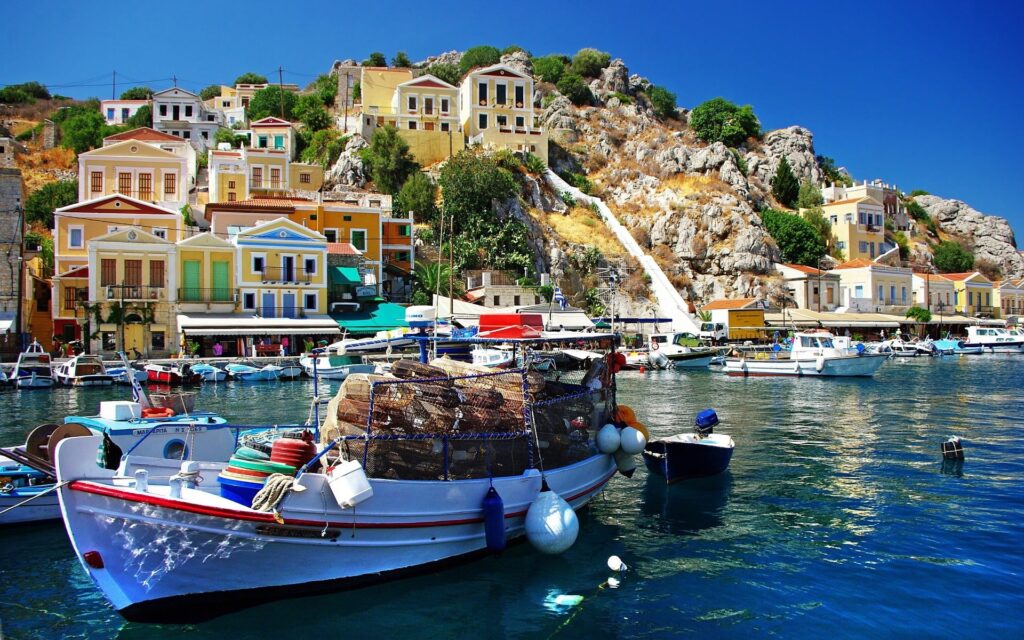
Every Greek island has its own story, whether it’s a tale of gods and giants, or the drama of modern history – often connected with the Greek revolution in the 19th century, when most islands were freed from 500 years of Ottoman occupation.
Arriving at any of them brings excitement and anticipation, especially if it’s by ferry (often the only way) or on a smaller boat (the most magical) and the first glimpse is a taste of their beauty.
It’s 50 years since I first visited Greece. I was 16| and I fell in love. Unlike many teenagers on a first trip to Greece, it wasn’t with a waiter. It was with the place itself: the island of Paros in the Aegean.
Childhood holidays had mostly been spent in Bognor Regis, where the sea was brownish and the beach was lumpy with pebbles. Wind and rain often sent us running back to the Ford Popular to eat our sandwiches (by then filled with sand).
The contrast between the English Channel and the Aegean was vast. I was astonished by the impossible blue of the sky and sea, along with the warmth of the water. Everything seemed magical.
And so, this love affair continued and became like a marriage, with the eventual purchase of a house in Crete many decades later – inspiration for my writing, the learning of the language and even Greek citizenship. I can now vote for my local mayor, so I couldn’t be any more involved in island life (maybe apart from becoming the mayor, which might be a step too far).
I made a promise to myself, even a decade ago, that as soon as islands began to blend into one another, I would stop. But with the landscapes and culture of almost 50 of them distinguishable in my mind one from another, I don’t plan to. Morc than 200 out of the 6,000 are inhabited, so I have plenty still to discover. Some of my favourites are among the best known, a few of them are just dots on the map, but equally worth the journey.
1 Epic experiences on Chios
The island believed to have been Homer’s birthplace is Chios, in the northern Aegean.
For the past few years, I have been mildly obsessed with The Odyssey. My new novel, The Wine-Dark Sea (the title is a quote from Homer’s epic), is not a retelling, but has as its theme the huge disruption caused by a civil war and the difficult journeys that have to be endured to find home once again. Chios is one of the least touristic of all Greek islands but is full of charm and surprise. Situated only seven kilometres from the coast of Turkey, it is rich in history with numerous Ottoman monuments. including mosques and baths. There are several medieval villages. The most spectacular is Pyrgi. known as the painted village, where houses are covered in complex geometric patterns.
By contrast, in the Kampos area, there are many mansions set in the midst of citrus groves, many with ornate patterned patios known as lilodota, crafted from black and white pebbles.
One of the things Chios is best known for is the unique Mastica tree that ‘weeps’ a very distinctive, aromatic resin used for making liqueurs and digestive remedies, and there is a superb museum that describes the history and the process that has provided the island with significant income over past centuries.
As well as paying homage to Homer whenever I have visited, I am always drawn to take a walk around the former leprosy hospital. a sister to Spinalonga, where my first novel, The Island, was set. It is in a state of abandonment these days, but was the first place of its kind in Europe and originally built in 1378 by the Genoese who occupied the island at that time. The ‘Lovokomeio”, as it is known, is in a beautiful, lush valley and cared for patients over hundreds of years before the cure was found. It might not be a classic tourist destination, but I always try to step away from the overtrodden path on my exploration of Greek islands, and in such places inspiration comes.
2: Ios the classically Cycladic isle
At one time known as a party island, Ios is a quintessential Cycladic island with white-washed houses and narrow alleyways.
With a very rocky landscape, cliffs drop down to spectacular sandy beaches with some of the clearest waters in the Aegean for swimming and snorkelling. And after visiting the beautiful, remote site that is supposedly Homer’s burial place, I always go and light a candle for him in one of more than 300 tiny churches (some say there is one for every day of the year).
3: Idyllic Ithaca
The Ionian home of Odysseus, Ithaca is, for me, one of the most magical of all islands – idyllic and timeless. It is relatively green with plentiful trees and beautiful turquoise waters with endless swimming possibilities and is blessed with great fish tavernas. There are many equally appetising small boutiques selling irresistible dresses and jewellery that perfectly suit the island climate and, in the heat of the day after lunch, a cool, air-conditioned shop is a great place to spend half an hour.
4: Paradise found on Kefalonia
Apart from a mention in The Odyssey, nearby Kefalonia (called Samos in the epic) is famous for one of Greece’s most spectacular beaches, Myrtos, with its stunning white pebbles. Until I visited, I thought they must be exaggerating the colours on all the postcards, but it’s real, a glimpse of paradise.
For some years, the island was under Venetian rule and the architecture reflects this. Even though a massive earthquake in 1953 destroyed many buildings, some places avoided the destruction, such as Fiskardo in the north and exquisite Assos, which almost disappears beneath all its pink bougainvillea in the summer. As well as being one of the prettiest places on any Greek island, Assos has some of the tastiest fish in Greece
5: Homer’s ‘fair rich land’ of Crete
Crete remains my favourite of all the islands, and, of course, is mentioned by Homer, who described it as: a land called Crete in the midst of the wine-dark sea, a fair rich land. surrounded by water, and there are many men in it, past counting, and 90 cities.
It is the biggest island, has the most significant archaeological remains and the best food of all. It would take a lifetime to explore every village and every bay, and I never tire of it. I think of Crete as a country rather than an island and it certainly is a ‘fair rich land’ with plateaus for growing vegetables, mountains to climb, hundreds of bays to swim in, dozens of museums, village restaurants (where braised goat is usually on offer and some of the most luxurious hotels in Greece, where sophisticated nouvelle-Greek-cuisine is now the norm.
The Cretans are famed for their tradition of filoksenia (hospitality) and if you find yourself in a village during one of the summer festivals, they will teach you to dance and share with you a plate of succulent lamb. You might find yourself staying until two in the morning listening to the Cretan lyra the unique three stringed instrument – and knocking back glasses of raki, when you will be obliged to echo the refrain of yamas – cheers!
Whenever I study a map of Grocee and the seas around it dotted with islands large and small, I realise that my journey is far from done. I have so many more to discover.