

Victoria Hislop’s voice was breaking up on the other end of the phone line, but I caught her greeting in unmistakably Greek: “Ela!” (“Hello!”). She was away from London, touring to promote her new book, “The Wine-Dark Sea” (Headline Publishing Group), whose title draws on Homer’s description of the sea as “wine-dark” (oinops pontos). The Greek edition, titled “Skoteino Pelagos,” is due out from Psychogios on November 5.
(Margarita Pournara, Ekathimerini)
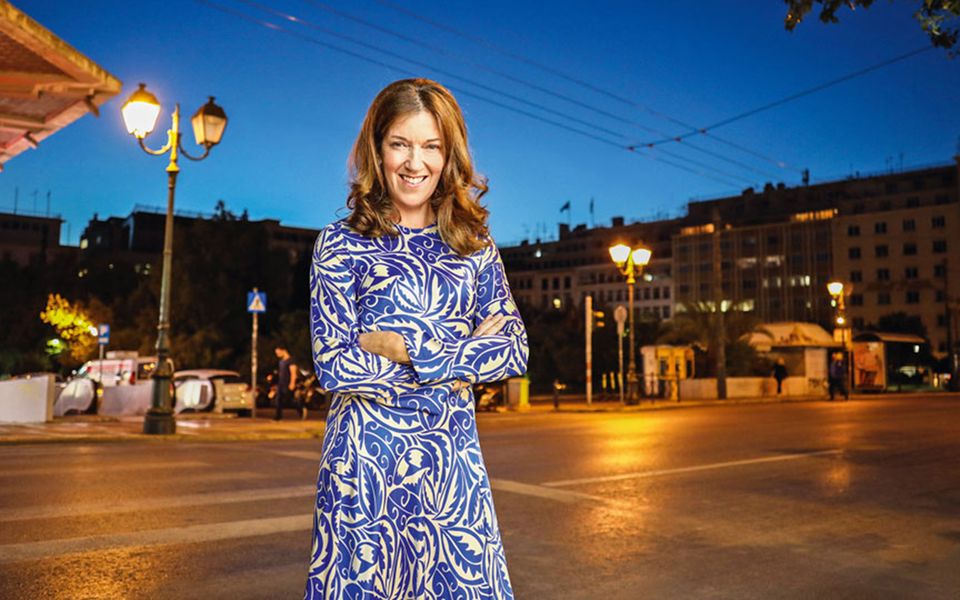
Hislop, who has been granted honorary Greek citizenship, has once again turned to Greek history, a source of inspiration for decades. Following the story of Spinalonga and its leper community, which captured the public’s imagination through her novel “The Island” and the television series of the same name, her best-selling fiction has explored the history of Thessaloniki, the Asia Minor Catastrophe, the German Occupation and the island prison camps of Makronisos and Trikeri. She has even tackled antiquities smuggling during the military dictatorship. One might say, half-jokingly, that we have become so convinced of her love for Greece that we trust her to revisit the collective wounds of our turbulent 20th century, knowing she will approach them with tenderness and a healing touch.
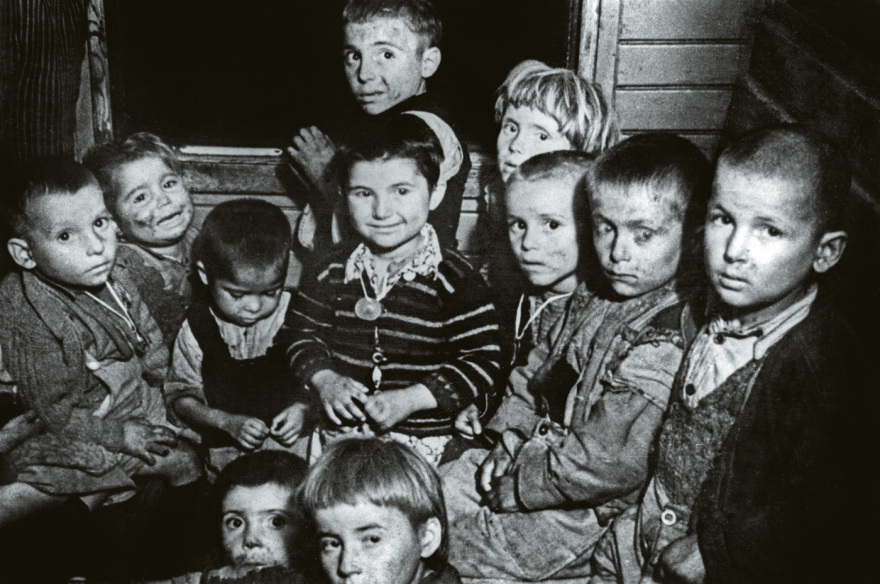
Her latest book, recently published in the United Kingdom and featured on the Times bestseller lists, is set against the backdrop of the Civil War. It explores how families were torn apart, how mothers watched their children being sent to children’s institutions or placed in overseas adoptions through networks of intermediaries. I ask her how familiar the average British reader today might be with the Greek Civil War.
“The most common response is that they had no idea what Greece has gone through – Occupation, civil war, dictatorship, persecution of people on the left. So many of my readers are people who love Greece and go there every year and they seem glad to know more about its sometimes hidden past. It doesn’t spoil their pleasure in going there in the 21st century.”
“They are shocked, first of all, that so many children were removed from Greece in the late 1940s and taken into communist countries such as former-Yugoslavia, Hungary, Romania etc – and of course many of them never came back. And they’re equally shocked that children were taken into orphanages (often when they might have a living parent) – and even more horrified that around 4,000 of them were actually sold to American couples, like a commodity, becoming little American citizens, with new names and identities.”
And what about Greeks living in Britain who attend her book presentations? “The themes of nostalgia and the longing for home strongly resonate with them. And it’s also fascinating how many people have personal connections with adoption, orphanages, loss of family and so on. It’s definitely touched an emotional chord.”
Perhaps the review that meant the most to her was written by Andrew Billen, the respected journalist at The Times:
“It is a harrowing, educative, rewarding story and I read its last pages through tears.”
“For me, these words were enough to make me feel that nearly four years of research and travel and writing had all been worthwhile just to read this one comment. Maybe in my whole writing career, I hadn’t felt a greater sense of achievement.”
A trip to Sounio
Hislop’s initial inspiration to explore the fratricidal conflict and the plight of political exiles came when her Greek publisher took her on an outing to the Temple of Poseidon at Sounio, from where she saw the island of Makronisos for the first time. The spark was rekindled during a visit to Chios, where she also saw sites where female political prisoners had been held.
To complete her research, she read extensively, traveled and spoke with members of the Greek diaspora, including people in the Hungarian village of Beloiannisz and the United States. She was also deeply moved by the research of Belgian-born scholar of modern Greek studies Gonda Van Steen, head of the Koraes Chair at King’s College London, which uncovered thousands of cases of Greek babies and children who ended up with childless couples in the United States and the Netherlands.
“Regarding the children who were sold to American couples – every one of them is unique and had their own individual experience. Some of them made me weep, their pain was almost unbearable. Others felt that they had been fortunate. Their lives had turned out well and they were grateful for the opportunity that had been presented to them. There are two sides of this story, too – just as there are for the civil war.”
Many believe that Greece still bears open wounds from that period, despite the achievements of the country’s transition to democracy after the fall of the dictatorship. Does she agree?
“I still find there is sensitivity about it, to say the least. And because I am fully conscious that there were atrocities on both sides, I resist taking a fully left or right point of view. I explore decisions people in the past made through my characters and this allows me to give a rounded picture of a situation. I could not, for example, write in the first person.
“And I think that the ‘scar’ is the stigma of perhaps having ancestors who killed or attacked one of their own countrymen or women in the past. It must make some older Greeks look inside themselves and wonder what makes people capable of that. But this has happened in most countries in the past and we seem to have a natural tendency to fragment and fight, then come back together and then repeat the pattern. It’s not just Greece where this happens – but perhaps the cycle is faster in Greece.”
Hislop tackles some of the most difficult chapters of Greek history, yet repeatedly manages to bring Greeks closer together through emotion and a shared sense of the past. What could be more challenging?
“It’s a very challenging challenge! I am not an academic historian, so I can only really look at history from certain angles. History tends to be mapped out by the decisions of men and certainly in the UK – and I think Greece, too – most history books are written by men – and actually the majority of decisions politically are taken by men, also.
“And if there are statistics on loss, or how many countries or kilometers of land are conceded in a battle, this does not fulfill my need to know about the effect on families, women, children, the old. I imagine situations of conflict from a human point of view, rather than political or military.
“So perhaps this is why I engage readers, through emotion – and in the case of Greek readers, a shared sense of a past which is collectively theirs, whichever side their ancestors might have fought on.”
A Greece beyond Greece
In researching the book, Hislop met many Greeks who had spent their entire lives outside their homeland. Their stories offered further insights into the Greek experience.
“Each departure from Greece in those decades was a response to a crisis – economic or political or social. And most of those I have met have found success or happiness or both.
“But, and there is a huge ‘But’. For nearly all of them, there is a strong sense of being Greek, even if they are perhaps third generation. And with that goes a nostalgia, an ache for their homeland. It might be satisfied by an annual visit back to a village in Greece or an island where they still have roots, or a relative. But for many there is a yearning that is not satisfied with this. So I think I sometimes get a sense of their emotion, something unfulfilled in them.”
What, ultimately, has stayed with her from the experience of writing the book?
“Perhaps the most intense encounter I had was with a very elderly man in Beloiannisz, the village built in Hungary, just south of Budapest, that was purpose-built for Greek refugees in 1950, adopting the name after the execution of [Greek Resistance leader and leader of the Greek Communist Party] Nikos Belogiannis. This gentleman had arrived there as a teenager, with his brother. He had never left.
“There are two things that are etched on my memory. He wore a felt hat, like a beret, with an enamel badge on the front: [the Greek letter delta] for Democratic Army. He looked like someone who was ready to return to Greece, but only as a communist, and he was a very proud man. And on the walls of his house, he had two faded color prints – one of the Parthenon, and the other of the White Tower in Thessaloniki. Those symbols of his ‘patrida’ (home country) I found very poignant, so many thousands of miles from the country of his birth.
“We spoke Greek together, but his day-to-day language was Hungarian and almost his whole life had been lived in a kind of exile. He was still so handsome, so hopeful. It was a very profound experience, meeting this man. Even though I don’t think he felt pity for himself, I cried later that day, as I often do when I am doing such research. Being next to someone who has suffered so much, I am always reminded how lucky most people of my generation have been, particularly in postwar Britain.”

