‘I was always Mrs Hislop but it was quite nice to be a bit more than that’
The graecophile writer who found literary success in midlife with The Island tells Andrew Billen why she can’t write her books in the King’s Road
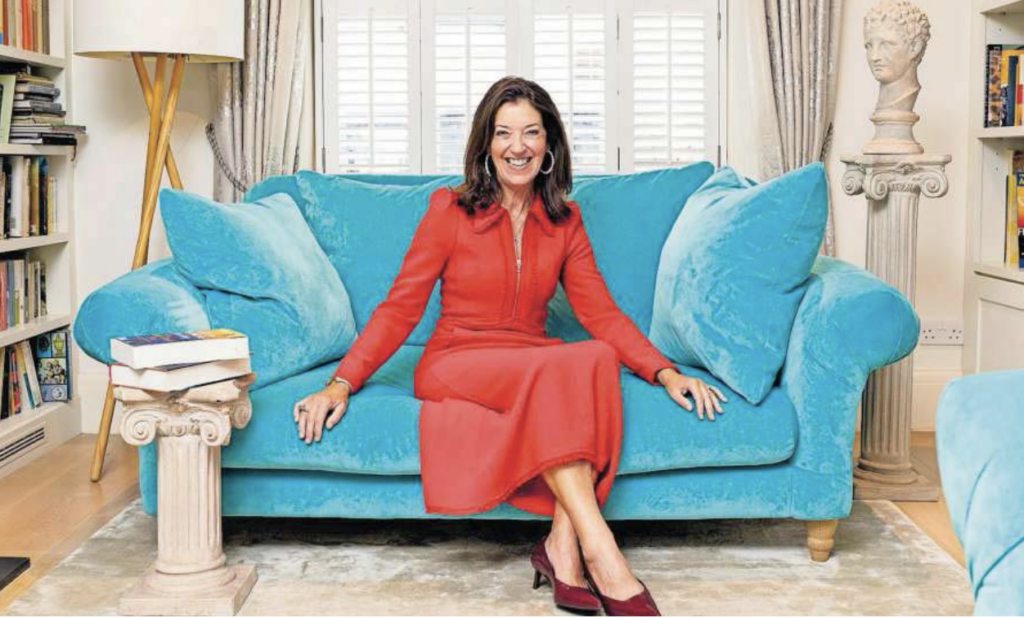
In 2001, when she was in her mid- forties, Victoria Hislop and her husband, the Private Eye editor Ian, holidayed with friends in Crete. She was discontented. “To be really open about it, that was a trip when I was desperately wanting a third child, as women often do,” she says in the sitting room of their Chelsea home, which is neatly bookcased and pristine but which she promises me she has anxiously tidied up before I arrive.
“It was like a visceral need, but actually I think the need was to create something, and on that holiday, where I was in a very odd mood, I went on that day trip and it came immediately. I felt completely fulfilled by just having that idea.”
That day trip was a boat ride to Spinalonga, an island off Crete’s northeast coast that from 1903 to 1957 served as Greece’s main leper colony. That idea was a novel about Spinalonga’s tragic history through the eyes of a British woman whose family’s past in Greece had been well- suppressed. The Island was published in 2005 and in the following two decades sold more than five million copies in more than 40 languages.
So the book was her longed-for baby? “No, the having of the idea, I would say, is a bit like falling in love. It’s the moment of the beginning of an obsession. All of my books I’ve been obsessed with, and they’ve all taken about two and a half, three years, and I don’t really do anything else.”
Hislop is about to publish her tenth and longest novel, The Wine-Dark Sea. Another leper hospital, this time on the larger island of Chios, plays a role, but it is also a story of the Greek civil war, nationalists versus communists, of family separation and displacement and of its protagonists’ Odyssean (hence the book’s Homeric title) determination to be reunited and return home. It is a harrowing, educative, rewarding story and I read its last pages through tears.
Her success as a novelist has transformed her public status. For 27 years before The Island came out, despite successful careers first in advertising (she drove a BMW at 28), then PR and finally travel journalism, mostly she was known as the wife of a man who had been in the public eye ever since becoming editor of Private Eye aged 26. In the very week of their older child Emily’s birth, Ian appeared on the first Have I Got News for You?
“Well, you don’t want to be elevated to the Ian levels,” she says, “but it would be dishonest to say, ‘Oh, no, I never felt I needed any more status.’ It did [make a difference]. It meant that people had something to talk to me about. It was great that people didn’t look over your shoulder at a party and move off. They were kind of interested for the first time. I was always Mrs Hislop. Or Ian’s wife. That didn’t bother me, but it was quite nice to be a bit more than that.”
And in Greece, where she is feted as a graecophile who bothered to learn to speak the language fluently, she is also known for her creditable stint on the country’s version of Strictly Come Dancing. So she is recognised there? “In Greece I am. And Ian’s not. And then here he is and I’m not.”
She is 67 but looks younger and also, oddly, rather Greek (face as fate?). While she is not exactly Lord Byron or Lawrence Durrell, she must be the most famous Brit currently writing about Greece — she and the author of Captain Corelli’s Mandolin, Louis de Bernières. “We have a sort of love/hate relationship. We kind of love being together but he always teases me for some reason. We’ve had great conversations where I’ll say to him, ‘Why are you considered literary? What’s the definition?’ And he says, ‘Well, you’re not considered literary’ — he’s very open — ‘because your metaphors, images, are usually rather clichéd. They’re not very original.”
I noticed there were very few similes in the new book. “Well, I’ve tried to strike most of them out now.”
There was one I thought was slightly odd. “Oh really? Tell me.”
I don’t want to be horrible. “No! Tell me!” It was something like “her mouth was as round as the full moon” (I check later: it was a boy’s eyes that were as round as the full moon). “That’s awful, isn’t it?” she says.
What a great sport she is!
But on the matter of her prose, I do say it is astonishingly plain. By the end I was so involved in the story that the words themselves became almost invisible, but an intelligent ten-year-old could read The Wine-Dark Sea. “That’s a great compliment,” she says. “I don’t think authors should try and be literary or try and be commercial. If you try too hard it just shrieks.”
When writing her novels she adopts, she says, the voice of her maternal grandmother. Because age grants perspective and wisdom? “Yes. And it gives you an excuse certainly not to write sex scenes. There’s a little bit of a prim and properness about it.”
The lack of sex scenes (originally a polite request from the publishers of The Island) in her books has certainly been noted, as has their absence of humour.
“There was one joke, again, way back, in one of my books and Ian said, ‘That’s terrible.’ So I took it out.”
This was a leprosy joke of the “there’s no arm in it” variety?
“Yes! And that went,” confesses the official ambassador for Lepra, the UK- based international charity. But, she adds of her life with Ian, “I think I’ve got the sense of humour of the two of us — the kind of normal, day-to-day sense of humour.” Is he quite gloomy at home? “Not gloomy. But I think, more matter of fact. He has plenty of time to be amusing elsewhere.”
So observe the double paradox. Mr Hislop, for 36 years television’s Friday night wit, is “matter of fact” at home whereas Mrs Hislop, who is effortlessly funny and warm during our 90 minutes together, writes joke-free novels heavy with violence and sorrow, tales of Greeks mistreating one another terribly. I ask whether they still do. “There’s a lot of femicide happening in Greece. And I think there probably always has been. There’s been a kind of wave of it. I hate to disillusion you about Greece, but there’s quite a lot of darkness in Greece. And although I am thanked by the minister for tourism for my services to tourism, beneath the superficial, these stories generally are about Greeks being against Greeks. The fact they had a civil war is really no surprise, actually. It fits their personality. More people died in the civil war than during Nazi occupation because, you know, they were prepared to kill each other.”
The uncovering of a dark national but also a family secret drives The Island’s plot. Perhaps she knew the power of secrets because her own family had kept one from her. Aged 30 she learnt from a casual remark by her father that before she was born she had had a sister who died from asthma at the age of three.
After her mother died, she found at the back of a cupboard a box of photographs of Sonia and letters of condolence. “I often wonder if that was something to do with my parents separating. But, again, they’re both gone now so I can’t ask them. But it wouldn’t surprise me.”
She confesses that despite her general attitude to life — which seems to be that it is an opportunity to be grasped — she also harbours a tendency to catastrophise. The onset of Covid was one instance. If Ian had taken her attitude, she says, “we probably would have taken a cyanide pill”. But it was a bad time. As she was about to drive to Kent to spend lockdown in their cottage, she received a phone call to say her mother had died. That December she was diagnosed with breast cancer.
“Sometimes you look in the mirror, you look yourself absolutely in the eye and you think, ‘Am I looking at someone who’s dying?’ I had that experience. But then it was OK. It hadn’t spread. But at the same time, a friend of mine, almost identical time, same diagnosis, but her cancer had spread and she’s now dead.”
She had a lumpectomy but her thoughts flew to her mother who had also had breast cancer and, in her case, a mastectomy. The French man she was with following the end of her marriage — a bonhomous chef whom Victoria adored — went to France for the weekend to see his family and never returned. “I don’t think their relationship ever recovered from her breast cancer. And that was something that worried me when I had breast cancer. I thought, ‘This is when I’m going to become a sort of unwanted …’ Ian would never have abandoned me. He was completely the opposite. He was an absolutely incredible kind of carer, not carer, but he was incredibly wonderful.”
Ian and Victoria, who met when they were at Oxford University, have been married for 38 years. For fear of summoning Private Eye’s curse of Hello! I hesitate to invoke the cliché that theirs is one of the happiest marriages in showbusiness, but 38 years is a long time. I wonder, with Victoria in Greece almost every month and writing her novels in her home in Crete, what impact such frequent absence has on a relationship. “Oh, Andrew, it’s terrible!” she jokes and suggests I can write: “She broke down in tears at that point and I hastily left.” But seriously? “Gosh. Ian has got used to it. And seriously when you’ve been with someone for 46 years, you can’t expect somebody just to sit next to you all the time, every day and every night. I mean, you might expect that, but I don’t believe you have to do that to remain married. Ian always says to me, ‘Oh, you’re away.’ But I could say when I’m in Crete, ‘You’re away.’ I just throw it back at him: ‘Don’t be pathetic. I’m just in Greece.’ I’m quite sort of blunt about it. Because I want to spend time there and I love it. And I can write books there …”
She can’t write books here? “I can write them here, but in a billion years I’m not going to get any ideas living in the King’s Road. I’m just not interested and it’s not my inspiration. I think Greece is going to be providing me with more ideas. On my deathbed, you know, I’ll be going, ‘Oh, I just got this idea …’”